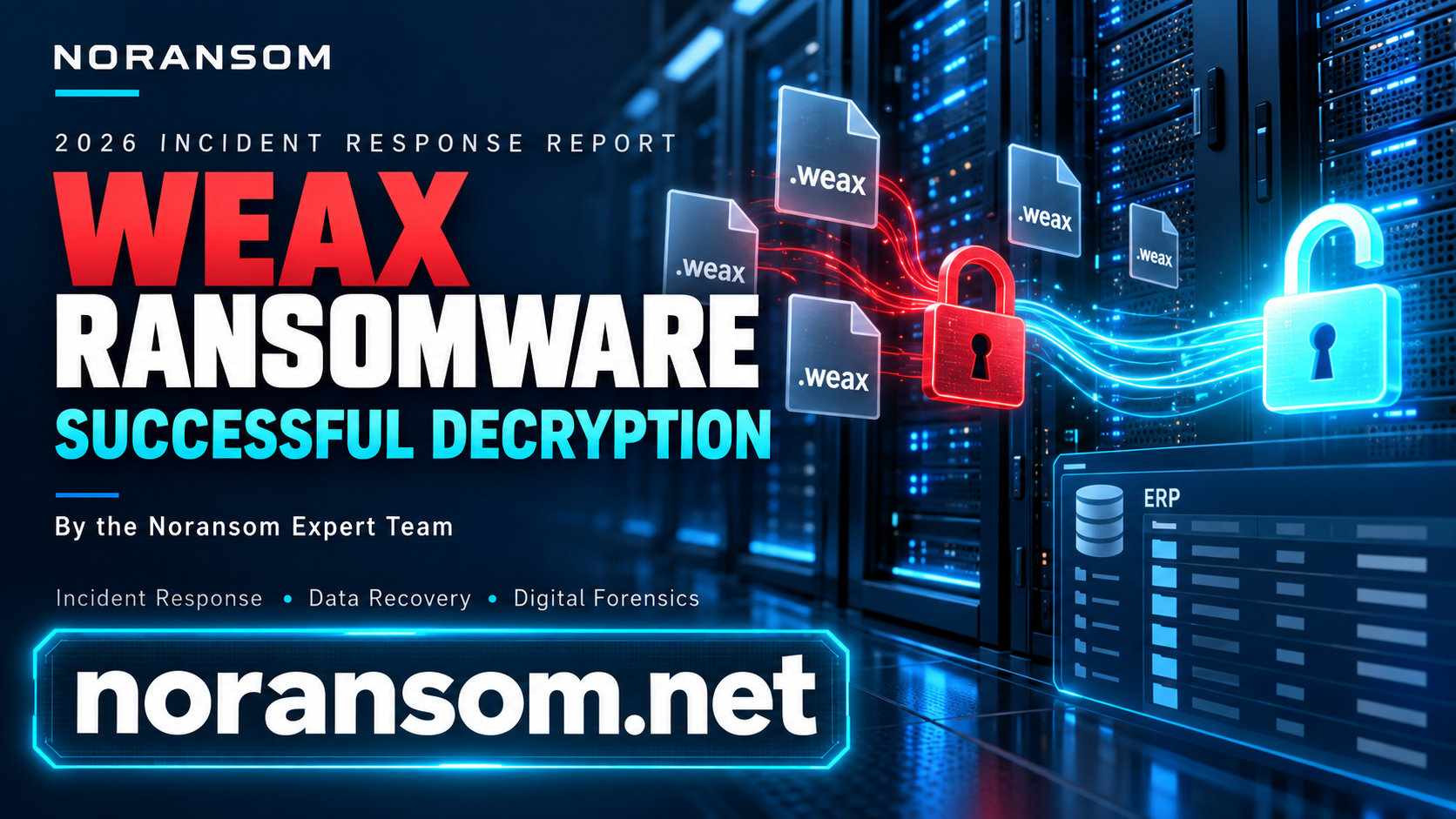
2026 Weax Ransomware Incident Response Report — Noransom Expert Team Successfully Decrypts Affected Data
An enterprise ERP system was operating normally when a Weax ransomware attack suddenly left its data encrypted. The business contacted Noransom for professional Weax ransomware decryption assistance, and the expert team successfully completed decryption in this case.
For businesses facing a similar incident, the immediate concern is practical: can the affected data be recovered, and what should happen before anyone attempts to repair the server? A successful response starts with protecting the remaining evidence and establishing which recovery options actually apply.
NoRansom
Official website
This report examines the threat background, the symptoms businesses should recognize, and the role of professional Weax ransomware incident response. The successful outcome described here is specific to the reported case; it does not establish that every .weax infection can be decrypted.
Weax Ransomware Remains a Business Threat in 2026
The name “Weax ransomware” commonly refers to infections associated with the .weax extension. Public research links these infections to Weaxor, which has been described as a rebrand or successor of the Mallox/TargetCompany ransomware family.
In its August 2026 ransomware report, published on September 8, 360 identified Weaxor as the leading family in its victim-device feedback sample, accounting for 65.74%. This is a figure from one provider’s response data, rather than a worldwide infection rate.
The threat is not confined to China. Seqrite’s India Cyber Threat Report 2026 identifies Weaxor alongside Xelera as a contributor to elevated ransomware activity in January 2025. However, those combined figures should not be presented as a count of Weaxor victims alone.
For organizations running business applications and databases, these findings make Weaxor a relevant threat to include in security reviews and recovery planning.
What Businesses May See After a .weax Infection
An attack may first appear to be an application failure. ERP users cannot retrieve records, accounting software loses its database connection, or documents on a shared drive stop opening.
File inspection may reveal the .weax extension appended to affected filenames. Ransom notes can also appear in accessible directories. The combination of unreadable files, changed extensions, and payment demands should trigger an incident response assessment.
These symptoms require careful interpretation. A filename extension is an identification clue, not a complete diagnosis. Responders need to examine the ransom note, encrypted samples, system activity, and the condition of affected storage before selecting a recovery method.
Why Antivirus Removal Does Not Restore Encrypted Files
Antivirus and endpoint security tools can help detect or stop malicious activity. Removing ransomware after encryption, however, does not automatically reconstruct the original data.
A server may be free of the active encryptor while its database remains unreadable. Restoring an application installation also cannot repair encrypted business records by itself.
This is why ransomware removal, ransomware decryption, and business recovery are separate tasks. Each addresses a different part of the incident, and each needs its own verification.
Noransom’s Successful Decryption: A Case-Specific Outcome
In the enterprise case described here, Noransom successfully completed decryption of affected data. The result should be understood within the conditions of that engagement, rather than as a claim that a universal Weax ransomware decryptor exists.
For another organization, the available path may depend on the ransomware variant, usable key material, encryption coverage, surviving backups, and previous changes made to the affected system.
Decryption and data recovery also mean different things. Decryption reverses encryption when the necessary conditions are available. Recovery may instead retrieve usable information from clean backups, snapshots, unaffected copies, or surviving readable structures. Database repair cannot recreate content that has been fully overwritten by strong encryption without the required means to reverse it.
A professional assessment should explain which path is being proposed and how its result will be checked.
From Incident Containment to Business Validation
Noransom provides ransomware incident response, decryption assessment, data recovery, and forensic investigation. Its service process begins with identification and recoverability assessment before implementation.
For an ERP incident, containment should address affected servers, shared storage, and backup access. Evidence preservation should retain ransom notes, encrypted samples, and relevant logs, while recovery experiments should use copies where possible.
Recovered database files then need integrity checks and application-level validation. A file opening successfully is only one checkpoint; the business must confirm that important records and relationships remain usable.
The response should also investigate the entry point and any remaining attacker access. Otherwise, restoring data may leave the organization exposed to another encryption event.
Noransom does not pay ransoms or negotiate with attackers. Its work focuses on technical recovery options and security remediation.
What to Do If Your Files Have Changed to .weax
Isolate affected systems from other devices and protect clean backups. Preserve the original encrypted files and ransom notes.
Avoid formatting, reinstalling, or running unknown decryption tools against the only copy of important data. Decisions about shutting down a server or stopping an active encryptor should reflect the immediate containment needs and evidence available.
When requesting assistance, provide the time the problem was discovered, the affected applications, example filenames, and the status of backups. Sensitive samples should be exchanged through an agreed secure channel.
Noransom offers 24/7 ransomware incident response for businesses facing encrypted ERP systems, databases, file servers, and virtual environments. Recovery scope and timing are established through assessment and verification.
If your organization needs help with Weax ransomware recovery or .weax file decryption, visit noransom.net to contact the response team and arrange an assessment.